

The Pump Bottle by the Studio Coffee Maker and the Nine Herbs Inside
A small-town radio man who took one long breath before every 5 a.m. signal for forty years starts counting the stops on the studio stairs. The label, the honest research and the return terms, read like wire copy.

First, the housekeeping: Gene Halvorsen is a pen name. Lupe, Kara, the station and the twenty-two stairs are composites, the way small-town radio stories have always been told.
Everything about the bottle itself, its label, its price, its directions, its reviews and its return terms comes from the seller's own pages, read in October 2026.
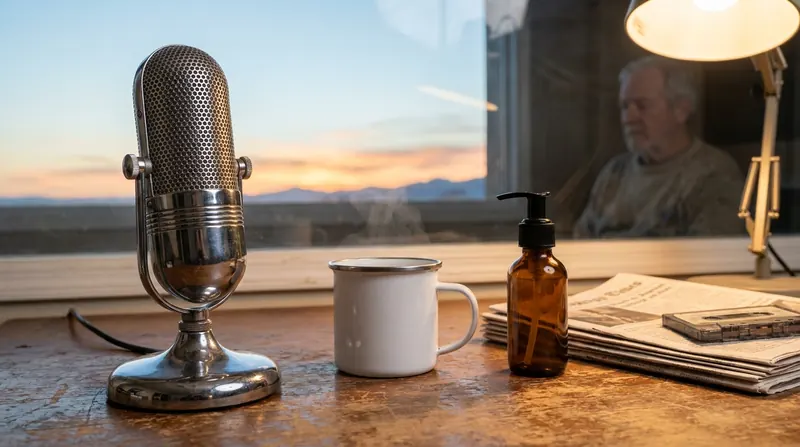 On Air at 5 A.M.
For forty years, my working day started at 4:58 in the morning with one long breath.
You learn to take it before the red light comes on. The microphone hears everything, and the first thing it should hear is a steady voice, not a man catching up with his own chest.
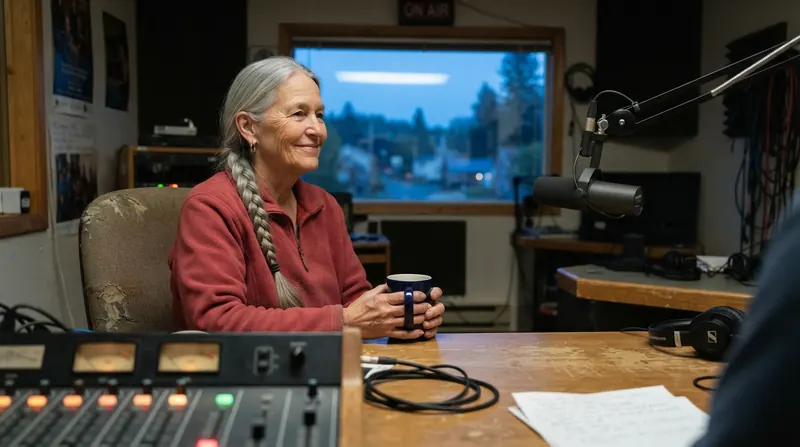
I read the morning news on a volunteer radio station in a mountain town in Colorado from 1985 until the spring I turned sixty-two. It's a 3,000-watt signal on a ridge, a studio on the second floor of an old 1911 bank building, and twenty-two stairs between the street and the microphone.
I climbed those stairs something like nine thousand times. I never counted them until the winter they started counting me.
This is a story about those stairs. It's also about a pump bottle that showed up next to the studio coffee maker, nine herbs on a label, and what I found when I read that label the way I used to read wire copy at five in the morning.
If you've ever stopped on a landing and pretended to look at a bulletin board, you'll recognize most of this. You just haven't heard anybody say it on the air.
Forty Years of One Long Breath Before the Signal
The old-timers at the station had a name for whoever drew the 5 a.m. shift. They called him the morning inhaler, because the job began with a breath you could hear across the room.
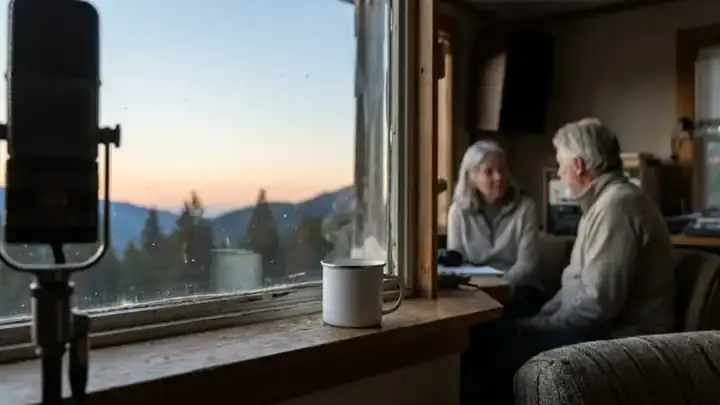
I inherited the shift and the nickname from a man named Arvid, who'd done it since the station went on the air. Arvid taught me three things in my first week, and I've never forgotten any of them.
First: you breathe before the light, never after. A breath after the light goes out over the air, and the ranchers listening in their pickups will hear it.
Second: you read the weather slowly. People up here make real decisions off the weather, and a man who rushes the wind speed is a man who gets letters.
Third: the stairs are part of the job. "If you can't make the stairs without stopping," Arvid said, "you'll start the show out of breath, and then you'll spend the first ten minutes catching up."
I was twenty-three. I took the stairs two at a time and thought Arvid was making too much of the whole business.
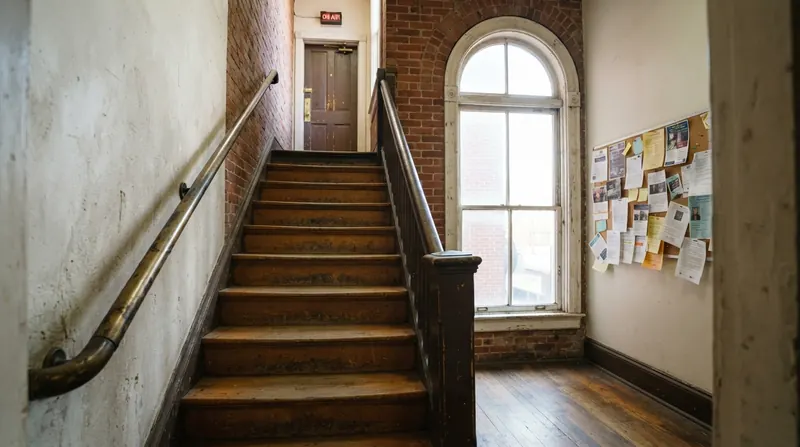
For thirty-some years, Arvid was wrong about me. I made the stairs every morning in the dark, in snow boots, with a thermos under one arm and the night's wire copy under the other.
Then, somewhere in my late fifties, he started being right. It didn't happen in one morning; it happened the way the snow line comes down the mountain in October, a little lower every week until one day it's in your yard.
When Twenty-Two Stairs Became Two Stops
The first stop came on a January morning, on the landing between the twelfth and thirteenth stairs. I told myself I'd stopped to read the bulletin board.
The bulletin board had the same lost-dog flyer it had held since Thanksgiving. I read it anyway, very carefully, while my chest caught up with my legs.
By February, the landing stop was a habit. By March, there was a second one, at the top, with my hand on the studio door and my forehead almost against the glass.
That second stop was the one that worried me. The top stop meant I was walking into the studio with my breath still behind me, which is exactly what Arvid warned me about in 1985.
I started arriving at 4:45 instead of 4:50, just to have the extra minutes. Nobody noticed, which is the advantage of working at a time of day when nobody else is awake.
I didn't tell my wife, Marlys. I didn't tell my daughter, Kara, who lives down in Denver and calls on Sunday afternoons.
I certainly didn't tell the listeners.
A radio man is very good at sounding fine. It's the one skill the job demands above all others, and I'd had forty years of practice.

What a Radio Man Does With a Stopwatch
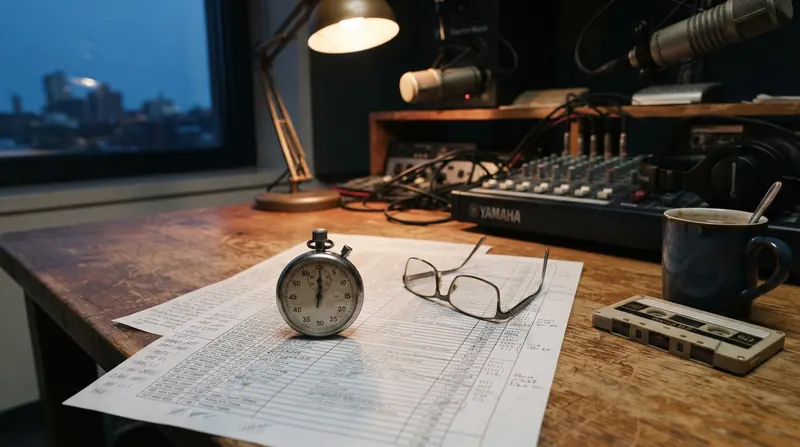
Radio people time everything. A newscast is four minutes and thirty seconds, a weather read is forty-five, and a station break is exactly as long as the engineer says it is.
So when the stairs started bothering me, I did the only thing I know how to do. I timed them.
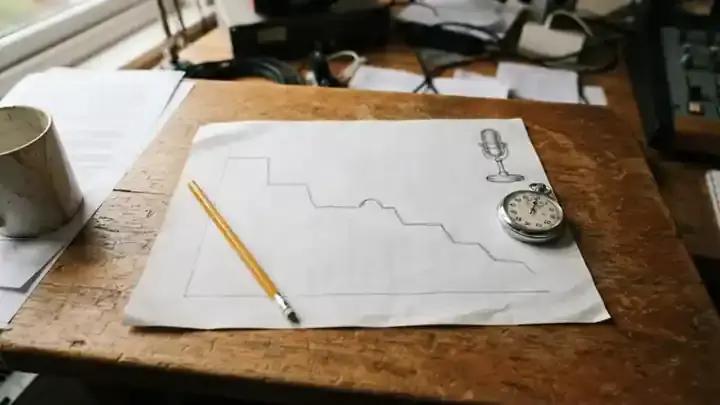
I kept the log on the back of old program rundowns, the long sheets that tell you what airs at 5:06 and what airs at 5:12. Every morning I wrote three numbers in pencil.
Number one: how many stops on the stairs. Number two: how many seconds from the street door to the microphone.
Number three was the one that mattered on the air: how many breaths I needed to read the first weather forecast without a pause in the wrong place.
In 1985, I could read the whole forecast, temperature to wind chill, on one breath and a half. By that first winter of the log, I needed three, and the third one sometimes landed in the middle of the word "afternoon."
Marlys found the rundowns in my coat pocket in February. She read them over her reading glasses for a long time and then asked, very quietly, how long I'd been keeping a log on my own breathing.
"Since January," I said. She said that was six weeks too long to keep it to myself, and she called the clinic that afternoon.
What She Listened to With the Stethoscope
My clinician is a quiet, thorough woman who grew up on a ranch two valleys over. She listens the way good radio listeners do, which is to say she doesn't interrupt and she notices everything.
She listened to my chest for a long time. Front, then back, then front again, asking me to breathe slow and then breathe deep, the stethoscope cold through my undershirt.
Then she sat down and told me the truth the way ranch people do. "Gene, your chest sounds like a sixty-three-year-old man who smoked for nineteen years and has spent forty winters in a valley full of woodsmoke."
I told her that was exactly what I was. She said she knew, and that was the point.
Here's the part I want to get right, because it's the most important paragraph in this whole story. She didn't hand me a verdict; she handed me a direction.
Walk every day, even in winter. Run the humidifier at night.
Keep the woodstove door shut tight when the fire's going, and keep an eye on the smoke reports in August.
"Come back in the spring," she said, "and tell me how the stairs are going. Sooner if anything changes."
I drove home and wrote the date on the next rundown sheet. Under it I wrote, in pencil: "Stairs.
Walking. Spring."
Mom says you went to the clinic. Why am I hearing this from Mom?
6:12Because your mother has a bigger signal than I do. It was a listen-and-talk visit: walk, humidifier, back in spring.
6:15And the stairs at the station?
6:16Two stops, and I'm logging them. You know I log everything.
6:18Nineteen Years I Wish I Could Take Back
I should tell you about the cigarettes, because every man my age who stops on a landing is thinking about his own version of them.
I smoked from 1979, when I was sixteen and working summers at the sawmill, until 1998, when Kara was nine and drew me a picture of our family with me standing outside the house.
She didn't mean anything by it. I was outside the house in the picture because that's where I always was when I smoked, on the back step, in all weather.
I quit the next morning, cold, and I've never had another one. But nineteen years leaves a cough behind, the deep morning kind that clears the pipes before the first cup of coffee.
For a long time, the morning cough was just part of the sign-on routine. Cough on the stairs, coffee in the studio, one long breath, red light.
I want to be careful here, because I'm a radio man and not anybody's clinician. Whatever the cough was and whatever it is now, the right person to listen to it is the one with the stethoscope, and I'd urge anyone carrying one like it to let them listen.
What I can tell you is how it felt from the inside. It felt like starting every morning a little behind, and spending the first hour of the day catching up with myself.
Woodsmoke in January, Fire Smoke in August
There's another thing about living where I live, and anyone in the mountain West will know it in their bones.
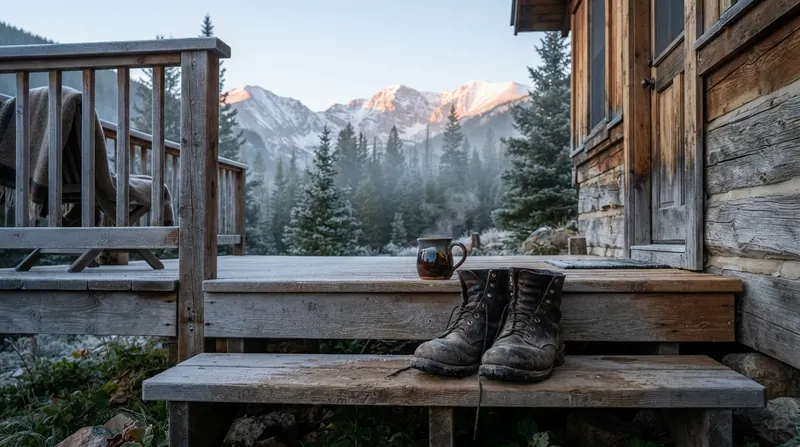
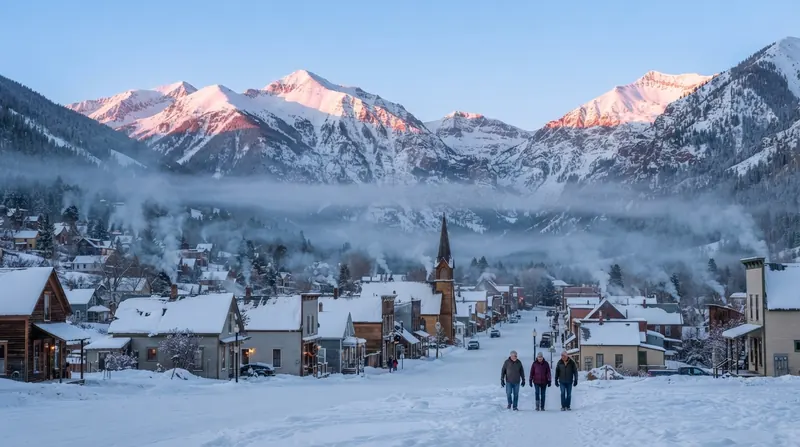
In winter, half the town heats with wood. On a cold still morning, the smoke from two hundred chimneys settles into the valley like milk in coffee, and it stays there until the sun gets over the ridge.
In late summer, it's fire season. Some years the smoke comes from a ridge you can see from the studio window, and some years it drifts in from three states away and turns the sun the color of a tangerine.
I've read a lot of air quality reports on the air. I used to read them in the same voice as the cattle prices, and I'm not proud of that.
Somewhere around the second stop on the stairs, I started reading them differently. When you've started counting your own breaths, you hear "unhealthy for sensitive groups" in a whole new way.
None of this is a verdict on anybody's chest, and none of it is anybody's fault. It's just the air in a beautiful place, and the arithmetic of forty winters and nineteen years of cigarettes.
What I Spent Before Anybody Set a Bottle Down
I promised myself when I started writing this that I'd be honest about the months before the bottle, because most stories skip them. A story that only tells you what worked is a commercial with the volume turned up.
So here's the receipt pile, the way I'd read a list of school closings, one at a time and without commentary.
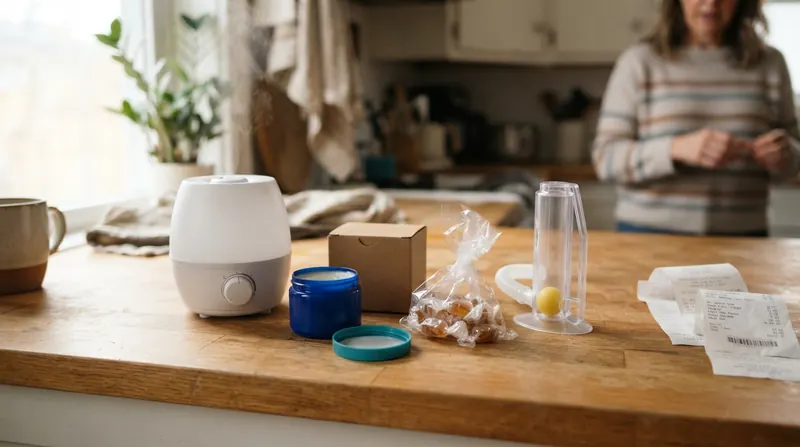
Item one: a cool-mist humidifier, $49. My clinician suggested it, and it's still running every night.
I'd keep that one. Marlys says the bedroom feels like a greenhouse, and she means it as a compliment about half the time.
Item two: a jar of menthol chest rub, $7.99. My mother used it on me in 1968, so I bought it out of nostalgia as much as anything.
It smelled exactly like being seven years old with a fever. The stairs didn't notice.
Item three: eucalyptus shower tablets, $12 for a box of eight. You set one on the floor of the shower and the steam smells like a cough drop.
I liked the shower. I didn't like paying a dollar and a half for every one, and the stairs, again, didn't notice.
Item four: a plastic breathing gadget from the hardware store's seasonal aisle, $34, the kind with a little ball that rises when you blow into it.
I used it faithfully for nine days. Then the dog carried it off and I didn't go looking very hard.
Item five: throat lozenges, about $40 a month, because I'd started taking one before the microphone every morning to keep my voice smooth through the first read.
Item six, the expensive one: an air purifier for smoke season, $189. I'd keep that too, for August, but it doesn't climb stairs for you.
Add it up and it comes to something over $330 in one winter. I tell you the number because I suspect plenty of you have a receipt pile of your own and have never added it up either.
Why the Stairs Are the Account Nobody Reads on the Air
In radio, the worst sound in the world is dead air. It's the silence when a record ends and nobody's at the board, and every announcer has nightmares about it.
After a few months of the log, I started thinking of the stairs as my own dead air. It wasn't a crisis and it wasn't an emergency; it was a gap in the morning that nobody else heard.
Here's what I mean. My clinic visit was about fifteen minutes long, and fifteen minutes is barely enough for the stethoscope, the questions and the arm cuff.
My clinician is a careful woman. But nobody has fifteen minutes in a clinic day to talk about a landing, a lost-dog flyer and a man pretending to read it.
And nobody builds a big campaign around a man taking a breath on the stairs. It's too small for the appointment and too stubborn for willpower.
So the stairs lived in the gap. That's exactly where Lupe walked in, at 4:40 on a February morning, with a thermos of her own and a small amber bottle in her coat pocket.
What a Weather Reader Leaves by the Coffee Maker
Lupe Archuleta is sixty-eight and has read the night-shift weather on our station for nineteen years. She records the 3 a.m. forecast and the road report, and she's usually pulling her coat on when I come up the stairs.
Before that, she spent twenty-six summers as a fire lookout in a little glass cab on top of a mountain. She knows more about smoke and wind than anybody I've ever met, and she can tell you which ridge a column is rising from by the color of it.
She noticed the landing stops before I'd admitted them to anybody but Marlys. Lookouts notice things that move slowly; it's the whole job.
On that February morning she didn't leave when I came in. She poured two coffees, sat down in the guest chair across the board, and watched me catch my breath with the professional interest of a woman watching a slow-moving weather front.
"Two stops this morning," she said. "I counted from the landing."
I told her what I'd told myself. It's nothing, Lupe, it's just my age and the woodsmoke.
She looked at me over her coffee for a long moment. Then she said it slowly, the way she reads wind speeds: "Your age explains the stairs; it doesn't explain why you're coming in fifteen minutes early to hide them."
That sentence sat in the studio with me through the whole 5 a.m. newscast, and I read the cattle prices worse than I've ever read them.
When the red light went off at 5:30 for the network news, she took a small amber bottle out of her coat pocket and set it next to the studio coffee maker. It had a black pump top, the kind you'd see on a bottle of hand lotion, and a blue label with a night sky and a line of mountains on it.
Then she tore the back off an old weather printout, wrote on it with the grease pencil we use on the tape cartridges, and tucked it under the bottle.
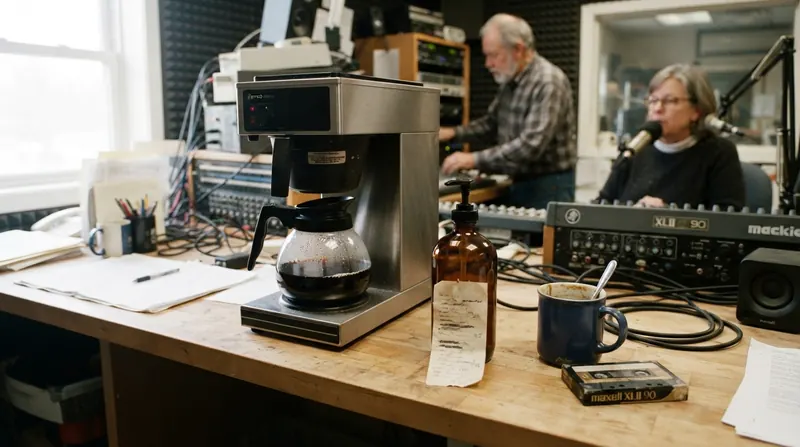
I read that note four times between the network news and the 6 a.m. weather. Then I did the radio thing: I put the bottle on the shelf above the coffee maker and decided to read the whole label on the air in my head before I'd let it anywhere near a cup.
Did you read the label, or is it filed under "wire copy, later"?
2:41Twice. It's on the shelf until I've read every line and called the clinic.
2:44Good, that's the right order. My grandmother would have said the same thing.
2:45Your grandmother would have made me climb the stairs twice for asking.
2:47Why a Fire Lookout Trusts a Mountain Root
The next morning I stayed after the 6 o'clock weather and asked her where the bottle came from. She'd been waiting for me to ask; lookouts are patient people.
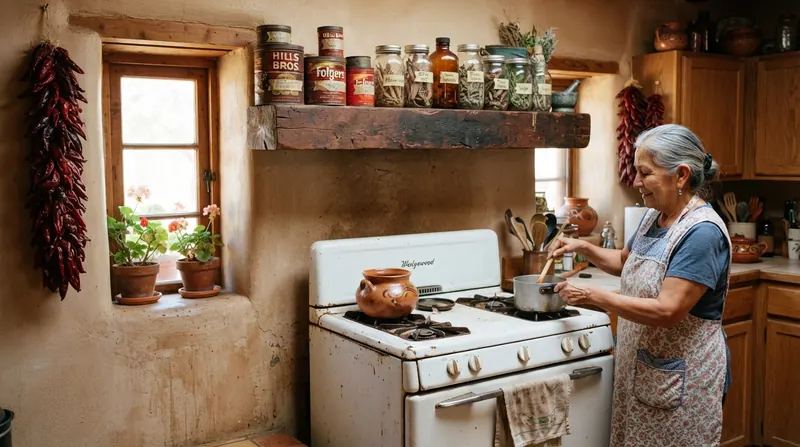
Lupe grew up in the San Luis Valley, in a family that kept the old plant knowledge the way other families keep a quilt. Her grandmother kept dried roots in coffee cans on a shelf above the stove, each can labeled in Spanish on a strip of masking tape.
One of those cans held osha root. Her grandmother called it by its old valley name and dug it high in the mountains in late summer, and every winter a little piece of it went into the soup pot.
"I'm not telling you it does anything for your stairs," she said. "I'm telling you I recognized four of the plants on that label from my grandmother's shelf, and that's why I picked it up in the first place."

Her own reason was simple. Twenty-six summers in a lookout cab breathing smoke from other people's fires, and a chest that let her know about it in the mornings, the way mine did.
Her clinician, like mine, had given her a direction instead of a verdict. And Lupe, like her grandmother, wanted something she could read.
"I won't put anything in my cup I can't find on a mountain or in a garden," she said, and she tapped the label with one finger. "Nine plants, and I can picture every one of them."
She'd found it at a little herb shop over the pass, then later ordered from the company directly. It comes from WishGarden Herbs, a Colorado herb house that's been making liquid herbal extracts since 1979.
"It's not a way out of being sixty-three, Gene," she said, getting up to leave. "It's a bottle of mountain plants.
Read it like you read the wire."
I've thought about the way she said that a great deal since. She didn't promise me anything, and she didn't use one big word; she gave me a list and a reason.
In my experience, people who are selling you something give you promises; people who care about you give you a list.
The Label, Read Like a Bulletin at Five in the Morning
So here's what I did with the bottle, the way I'd have handled a bulletin coming off the wire. I read every line on the label, then I went to the company's own website and read every line there.
I'll go through it in order, because order matters in a newscast. Whatever a company puts first is usually what it wants you to hear; whatever it puts in small type is usually what you need to know.
The product type. The front of the 2 oz bottle says "Herbal Supplement," and the company describes it as a liquid herbal extract made with vegetable glycerine, Rocky Mountain spring water and organic alcohol.
That matters for the reason Lupe gave. A liquid means you can see and smell what you're taking: there's nothing to swallow whole, and you take it in a little water, juice or tea.
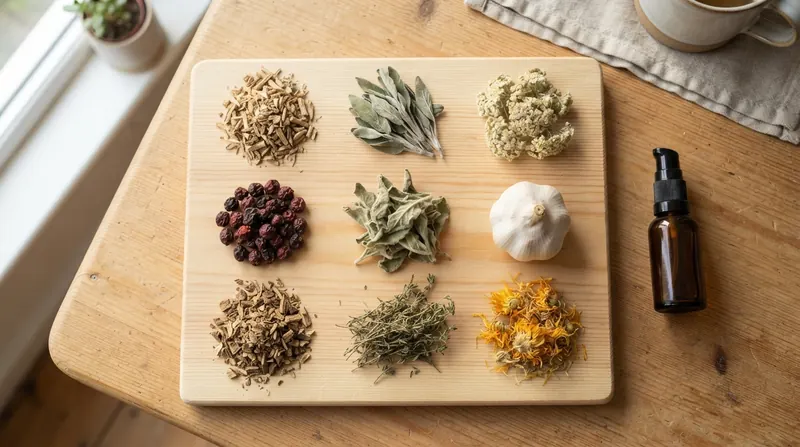
The ingredient line, in the order printed. Elecampane root, angelica root, yerba santa leaf, yarrow aerial parts, hawthorn berry, mullein leaf, yerba mansa root, garlic bulb and osha root.
Nine ingredients, and every one of them a plant. There's no sweetener listed apart from the glycerine and no flavoring, and nothing on the line I'd need a dictionary for once Lupe told me what yerba mansa was.
The amounts. Here's the first small-print item, and I'll say it plainly: the company doesn't print how much of each herb is in the blend.
That's ordinary for a multi-herb formula, the way a spice blend doesn't tell you how much paprika it holds. But it means nobody, including me, can honestly compare a serving of this bottle to a study that used a measured amount of any single plant.
The serving. The label's serving is 3 mL.
The directions say: "For immediate support: 3mL in water; repeat as needed. For extended support: 3mL every 1-3 hours for up to 5 days."
The limit. This is the line I'd want every listener to hear, so I'll read it twice: "Limit to: 10 servings per day.
Not intended for long term use."
Read it again. Not intended for long term use.
This is a bottle for a stretch of rough mornings, up to five days at a time by the label, not a daily habit for the rest of your life.
I liked that line more than any other on the bottle. A company that tells you when to stop is a company that's thought about you after the sale.
The cautions. The label says it's "Not for use while pregnant or nursing," asks anyone with a health condition or a daily routine from the pharmacy to check with their own practitioner first, and says to keep it out of reach of children.
The statement at the bottom. The company's page carries the standard sentence that these statements have not been evaluated by the Food and Drug Administration, and that the product isn't meant to stand in for medical care.
Most people's eyes slide right past that sentence. That sentence is the most honest line on any supplement label, and it outranks every other line, including the name.
And the name is the part I'd circle with the grease pencil. The product is called "Deep Lung, Bronchial Support," which is a name, not a finding, the same way a radio station called "Mountain Country" doesn't put a mountain in your kitchen.
The company's page uses some confident language of its own about how fast it works, and I won't repeat it here. I'll tell you what the research files say instead, which is what the next section is for.
What the Files Say, Plant by Plant, Including the Shrugs

I spent three afternoons at the county library, and Marlys came twice because she wanted to see what a newsroom looks like when it's just one retired man and a stack of printouts. Here's what the file says, and I'm going to read the shrugs in the same voice as everything else.
Elecampane comes first on the label, so it comes first here. It's a tall yellow daisy-like plant with a big root, and it's been in European herb gardens for a very long time.
Elecampane root is a traditional European herb whose documented uses center on coughs and the chest.
The evidence base is traditional, not clinical: no modern clinical trials in humans are listed in the reviewed sources.
— Herbal references on Inula helenium, summarized, The evidence file on elecampane root[1]
That's the honest summary, and I'll read the important part again. Traditional, not clinical.
Elecampane has a long record of use and no modern human trials in the file. I'll take it as a plant with a long history and nothing more.
Mullein is sixth on the label. You've seen it even if you don't know the name: the tall fuzzy stalk with yellow flowers along every roadside and ditch in the West.
Mullein has long been used for respiratory ailments, and its leaves and flowers are reported to have expectorant and demulcent properties.
The relief could be explained by the presence of mucilages that exert demulcent activity.
— Moreno and colleagues, Biology, 2021, A review of mullein's folk uses and chemistry[2]
"Demulcent" means it forms a soothing, slippery film, the way honey does in a sore throat. The review is mostly about traditional use and laboratory work, not trials in people.
I'll say that in the same voice as the rest. A long tradition, a plausible reason in the chemistry, and very little testing in actual human beings.
Hawthorn berry is fifth on the label. Hawthorn is a thorny shrub in the rose family, and the berry is the small red fruit that hangs on the bushes into winter.
There is little or no quality evidence on hawthorn for most uses.
No studies have tested use beyond 16 weeks, and side effects can include dizziness, nausea and muscle aches.
— National Center for Complementary and Integrative Health, Plain-language summary of the research on hawthorn[3]
That's a government health center saying "we don't know" in plain English, and I respect it for that. It also reminded me of what Lupe said about the label: read the whole thing before you touch it.
There's one more thing about hawthorn worth knowing, and it's the kind of detail a careful reader catches. Most of the hawthorn research uses the leaf and flower; this bottle uses the berry.
That's not a small difference. Chemists who measured one North American hawthorn found the leaves held far more of the plant's best-studied compounds than the fruit did. [4]
I'm not telling you the berry is worthless or that the leaf is better. I'm telling you that a study of hawthorn leaf is not a study of hawthorn berry, and the plant part in the study ought to be the plant part in the bottle.
Then there are the other six: angelica, yerba santa, yarrow, yerba mansa, garlic and osha. I looked for files on each of them as they're used here and came back with tradition, history and kitchen knowledge, and no study I'd quote to you for this bottle.
That isn't a scandal. It's the normal state of affairs for mountain and garden herbs, and I'd rather say it on the air than have you find it out later.
So here's the research desk's summary, read slowly. One plant with a traditional record and no modern trials, one with a long tradition and some laboratory chemistry, one where the government says "little or no quality evidence," and six with history and no file.
And not one study of this bottle. If anybody tells you otherwise, ask to see the file.
Nine Plants, Read Like Nine Segments of the Morning Show
Every morning show has a rundown, the sheet that tells you what airs when. After three days at the library, I wrote the label out the same way, one plant per segment, because that's how my brain holds things.
I'm not a herbalist, and I'll tell you only what the plant is, where it grows and what tradition says about it. Where there's no research I'd quote, I'll say so and move on to the next segment.
5:00, the top of the hour: elecampane root. The lead story, first on the label, a tall yellow-flowered plant whose root has been in European herb gardens for centuries.
The file on it is all tradition and no modern trials, as I read you a few minutes ago. It leads the label, and it leads the rundown.
5:06, the weather: angelica root. A tall plant in the carrot family with big round flower heads, grown in northern Europe for a very long time and used in kitchens to flavor cordials and candied stems.
The company says angelica "has been used since ancient times." I'll take that as history, not a forecast.
5:12, the farm report: yerba santa leaf. A sticky-leaved evergreen shrub from the hills of California, and its Spanish name means "holy herb."
The company notes it was "traditionally revered in its native California." There's no study I'd quote you for it in this bottle.
5:18, sports: yarrow. The flat white flower heads you see in every mountain meadow in July, the ones that smell a little like pepper when you crush them.
The company repeats the old story that the Greek warrior Achilles carried it into battle, which is where the Latin name comes from. That's a good story for the sports desk, and it isn't evidence of anything.
5:24, the community calendar: hawthorn berry. The small red fruit of a thorny shrub in the rose family, the one with the government summary that says "little or no quality evidence" and the chemistry that says the leaf and the berry are different animals.
5:30, traffic: mullein leaf. The tall fuzzy roadside stalk with the yellow flowers, the one every ranch kid has been told a story about.
It's the plant with a long tradition and a demulcent explanation in the chemistry. That's the honest headline, and I'd stop there.
5:36, the swap shop: yerba mansa root. A low plant with white cone-shaped flowers that grows in wet, salty ground along streams and springs in the Southwest.
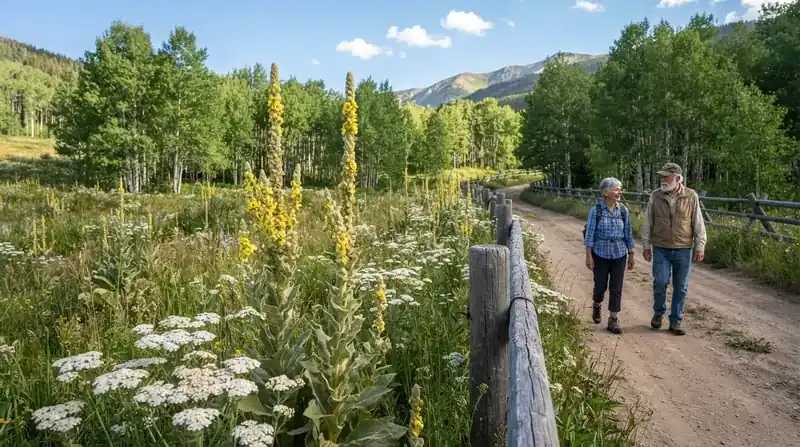
Lupe's grandmother had it on her shelf. I have no study to read you for it, and I'd rather say so than make one up.
5:42, the kitchen segment: garlic bulb. You know garlic; everybody's grandmother in the world knew garlic.
It's eighth on the label, and I'll come back to it, because it's one of two plants on this label I'd want to say out loud to a pharmacist. Hawthorn is the other one.
5:48, the mountain report: osha root. A plant in the carrot family that grows high in the Rocky Mountains, often above eight or nine thousand feet, with a root that smells sharp and a little like celery and something you can't quite name.
It's the root in Lupe's grandmother's coffee can, and it's the plant that made her pick up the bottle in the first place. I have no human study to read you; I have a family tradition from the San Luis Valley, and I'll leave it at that.
How I Actually Take It, Down to the Milliliter
I called my clinician's office before I opened the bottle, and I read them the label over the phone. The front desk wrote down all nine plants, and the clinician called me back that afternoon.
She said she had no objection to a short stretch of it, the way the label describes, and she wanted me to run it past the pharmacist because of the garlic and the hawthorn. Then she said what I'd hoped she'd say: "And keep walking, Gene.
The walking is the part I care about."
Sending you a photo of a label with nine herbs on it. Anything there that argues with my list?
10:05Thanks for asking first: garlic and hawthorn are the two I'd look at against what you take daily. Come by at lunch with your list and the bottle.
10:22I'll be there at noon. Bringing the whole bag from the cabinet.
10:23Perfect. That's the best kind of customer.
10:24
I went at noon with a grocery bag of every bottle from my bathroom cabinet, and she went through them one at a time at the counter. It took eleven minutes, and it cost me nothing but a thank-you.
That conversation is worth more than anything in this story, and I'd tell any listener to have it before the first pump.
Here's the routine I ended up with, laid out like a sign-on checklist, because the routine turned out to be most of the point.
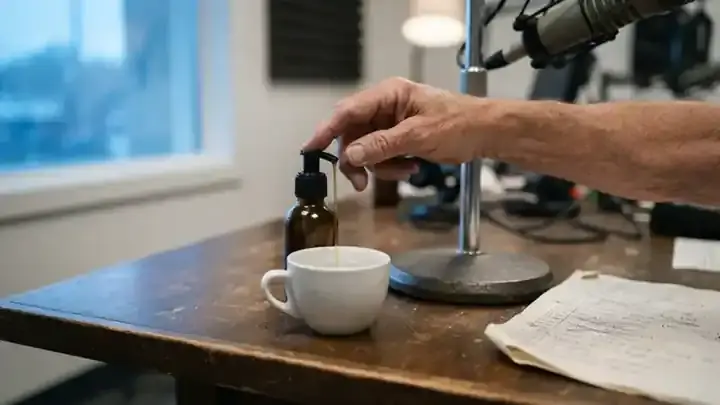
Step one: the cup. A small coffee cup with about an inch of warm water, or a splash of the studio coffee once it's cooled a little.
The label says "in a small amount of water, juice or tea to taste," and I took it at its word.
Step two: the measure. The serving is 3 mL.
I measured it the first week with the little plastic dosing cup from the pharmacy until I knew how many presses of the pump made 3 mL in my bottle.
The company shows how to measure one adult serving for each of its bottle types on its own page. I'd check yours against a measuring cup rather than take my word for it.
Step three: the stir. One stir with a spoon, and down it goes.
Step four: the log. A pencil line on the rundown: date, time, stairs, breaths on the first forecast.
That's all of it. Nothing to swallow whole, no device to plug in, nothing to inhale; just a small cup, a pump and a pencil.
And step five, which the label wrote for me: the stop. Up to five days at a stretch, no more than ten servings in a day, and "Not intended for long term use."
I never came close to ten in a day. I took it two or three times a morning during the rough stretches, and on the sixth day the bottle went back on the shelf.
What It's Like at 4:50 in the Morning
I'll be honest, because nobody else will tell you: it doesn't taste like candy. The glycerine gives it a little sweetness up front, and then it's woody and bitter like a root cellar, and the garlic arrives at the end like a late caller.
Michele G., one of the reviewers on the company's page, put it more kindly than I would have. "The taste is fine," she wrote, and in a little warm water I'd agree with her.
Marlys tried a serving once to see what the fuss was about. She made a face I'd describe on the air as "partly cloudy," and she hasn't asked for another.
The alcohol is there in the base, and you can taste it a little. If alcohol is something you avoid for any reason, that's one more line on the label to read before the first pump, and one more question for your clinician.
Not an Inhaler, Not a Habit, Not a Replacement for Anybody
Here's the part of every honest review that matters most: what the thing isn't. I'll read it like the closings list, one line at a time.
It isn't an inhaler. Our station name is a joke about an old radio man's breath, not a medical device; this is a liquid you take in a cup, and it doesn't replace anything your clinician has given you.
It isn't a daily habit. The label says up to five days and "Not intended for long term use," and I'd take that line more seriously than any line on the front.
It isn't a substitute for the stethoscope. Whatever's going on in your chest, the person to listen to it is the one with the instrument, and the bottle only rides along after they have.
It isn't a study. No one has tested this bottle as a bottle, and three of its nine plants have files I'd call thin, generous or "we don't know."
And it isn't a promise. The company's own FDA sentence says its claims haven't been evaluated, and I'd want you to read that line before any other.
I put that chart in because the number matters for the label's own limit. A 2 oz pump bottle holds about twenty servings, which at my pace was one five-day stretch with some left over for the next rough week.
What Customers Wrote, Word for Word
For thirty-nine years I read the listener mail on the Saturday show, and I learned to tell a real letter from a planted one by the second sentence. So here are the reviews from the company's own page, quoted word for word, with nothing improved.
The company's page shows a rating of 4.9 stars. I read every review I could see, and I've kept the ones that describe the bottle rather than promise a result.
Where a review goes on to make a claim about somebody's chest that no honest station would read on the air, I've cut it with three dots and left the rest exactly as written. The photos beside them are illustrative, not the reviewers themselves.

Very Nice Product, my daughter referred me to this lovely company for this product to help me~just what I needed! … Another addition to my herbal arsenal for life.
Theresa's review is the one that sounds most like Lupe. A daughter, a referral, "my herbal arsenal," and not a word about wonders.
I liked "herbal arsenal" so much I wrote it on the studio whiteboard. Lupe added "small" in front of it, which is exactly right.

I have been using this product for several years. … The taste is fine and the price is a good value
Michele's is the review I trust most, and it's because of the two plainest words in it. "Several years."
Anybody can be excited about a bottle in its first week. A customer who keeps a bottle on the shelf for several years, and then talks about taste and price, is telling you how it fits a life.

So excited to have this in my home health kit!
Rebecca's is short, and I like where she put it. A home kit is the right drawer for a bottle with a five-day limit on the label.

When I feel the first signs of congestion coming on I reach for WishGarden Herbs Deep Lung , Bronchial Support. …
Robert's review goes on from there, and I cut the rest because it makes a promise about speed that I won't repeat. What I kept is the part that matches the label: he reaches for it when a rough stretch starts, not every day of the year.
I read all four out loud to Lupe one morning during the network news. She listened with her eyes closed, the way she used to listen to the radio in the lookout cab.
"No big promises," she said when I finished. "Good.
Big promises are how you know somebody's selling something."
Twelve Weeks of Rundown Sheets, Good Mornings and Bad Ones
I started the first stretch on Monday, February 17, the week after Lupe set the bottle down. I'd like to say I started out of hope, but I started out of stubbornness, because Lupe was going to ask.
I kept the same three numbers as before, and I added one more: whether I'd walked the day before. My clinician cared about that column more than any other, so it went first on the sheet.
Gene's rundown log, February to May
- Week 1First five-day stretch, two or three servings a morning. Two stops on the stairs four mornings out of five. Three breaths on the first forecast. Taste: "root cellar, garlic at the end."
- Week 2Bottle back on the shelf, as the label says. Nothing new on the stairs. Walked twenty minutes a day along the river path with Marlys and wrote "nothing" five mornings running.
- Week 3A cold still week with woodsmoke sitting in the valley. Second five-day stretch. Landing stop most mornings, the top stop on two of five.
- Week 5Eighteen inches of snow in the night. Shoveled the walk at 4 a.m. and arrived with two stops and a sore back. Wrote "snow" in the margin and didn't scold myself.
- Week 7First morning in two years without a stop. Stood at the top anyway out of habit and read the lost-dog flyer, which had finally been taken down.
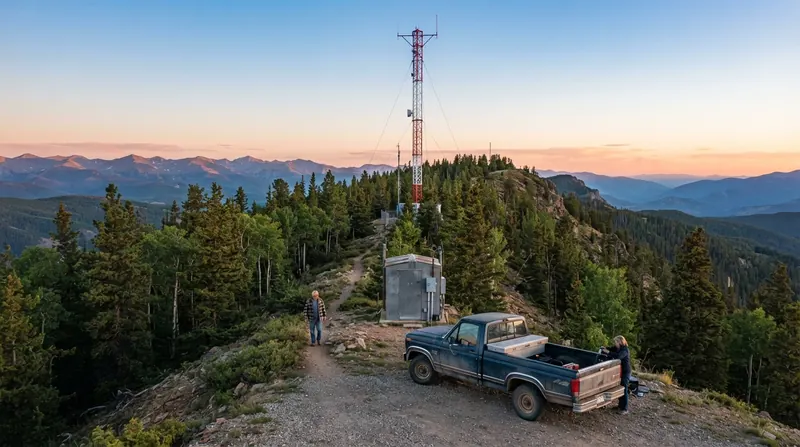
- Week 9The Saturday drive to check the transmitter on the ridge. Rested twice on the 140-yard path up from the truck, where in January it had been four times.
- Week 12Back to the clinic with a folder of rundown sheets in my coat pocket.
I want to slow down on week two, because it's the week most people would quit. Five lines in a row that say "nothing," in the handwriting of a man who already suspected he'd been talked into something.
What kept me going was the same thing that got me through forty years of 5 a.m. alarms. You don't judge a season of radio by its second week.
Week seven is the line I'd circle if I were grading this. "First morning without a stop."
I want to be honest about it, though, the way I'd correct a mistake on the air. By week seven I'd been walking every day for six weeks, the humidifier ran every night, and the woodsmoke had lifted with the first warm spell.
I can't tell you which of those did what. Nobody could, from one man's rundown sheets, and anybody who says otherwise is selling you a story.
In week twelve, my clinician listened with the stethoscope again, front and back and front, for just as long as the first time. Then she took the folder of rundown sheets and read them, every page, the way a good listener reads a letter.
"Keep walking," she said. "Keep the humidifier, keep the woodstove door shut, and keep that bottle where the label puts it, on the shelf between rough stretches."
She didn't tell me the bottle did anything, and I didn't ask her to. She told me the walking showed, and that's the most honest review this story has.

What Listeners Wrote When This Ran as a Short Segment
A shorter version of this story ran as a Saturday segment in the spring. The calls and comments afterward were better than the segment, which is usually how it goes in radio.
The comments below are illustrative, retold from listener notes with names shortened. Replies sit indented under the comment they answer, and they're here because they ask what you're probably asking.
Pat's comment is the one I've thought about most. "I park at the far end of the lot so nobody sees me stop."
I did the same thing with the extra fifteen minutes at the station. We invent a respectable reason, because the real one feels like a confession, and a confession at our age feels like a verdict.
And Carol's comment is the reason I'd read the research desk again tomorrow. Whatever you try, read the ingredient line, and then check the study against it; the plant part in the study ought to be the plant part in the bottle.
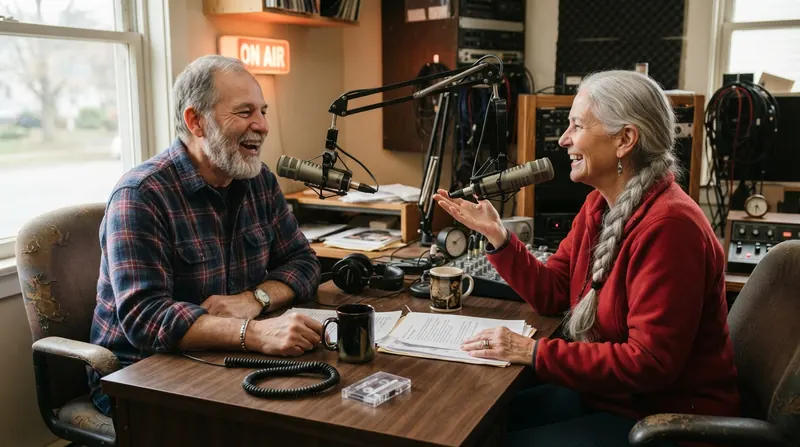
Valley Saturday · Porch and Pine, Episode 12
The Morning Man, the Lookout and the Bottle by the Coffee Maker
Gene
host
Lupe, the listeners want to know why a fire lookout left a bottle by my coffee maker instead of just telling me to see somebody.
 Lupe
guest
I did tell you to see somebody, and the bottle was for after. You were coming in fifteen minutes early to hide the stairs, which told me you weren't listening to anybody.
Gene
host
Fair. What made you pick that one off the shelf, out of all of them?
Lupe
guest
Osha, the root my grandmother kept in a coffee can, and then eight more plants I could picture and a line that said not for long-term use. A company that tells you when to stop, I'll listen to.
Gene
host
I told the listeners I can't separate the bottle from the walking. Do you think that's a cop-out?
Lupe
guest
I think it's the truth: on the lookout you never know which gust moved the smoke. You write down the wind and keep watching, and that's what your rundown sheets are.
Gene
host
Last word to you. What do you tell the listener who stops on their own landing tomorrow morning?
Lupe
guest
Tell somebody, let the one with the stethoscope listen, and walk a little every day. If you try a bottle, read the whole label first, the last line especially.
Lupe listened to the tape afterward and asked for one correction. She wanted it on the record that she's never once ducked behind a bulletin board on a landing, which Marlys disputes.
I've gone back to her last answer more than any other. "Read the whole label first, the last line especially."
2 oz pump-top bottle · about 20 servings · read the label's five-day limit before ordering
The Return Terms and the People Behind the Phone Line
I want to read the return terms slowly, because they're shorter than most and that's worth noticing. The company's policy says that if you're not satisfied, you can return the product for a replacement or a refund, and asks you to notify them within 30 days of purchase.
I called the number on a Tuesday morning, partly to check it worked and partly because I'm a radio man and I like to hear who answers. A woman picked up on the third ring and answered my question about measuring 3 mL with the pump without once trying to sell me a second bottle.
A street address, a phone line with a person on it and a return policy in plain words. My checklist for any advertiser in forty years at the station was three lines long, and this bottle cleared all three before I got to the taste.
The company has been in Colorado since 1979, and it says it was founded by a midwife and is woman-owned and family-run. That's not evidence about a bottle, and I won't pretend it is, but it is the kind of company that answers its own phone.
Shipping, for the record: the store's banner said orders of $45 and up ship without a shipping charge when I checked in October. There's also a subscription option at a lower price, and I'd skip it for a bottle with a five-day label limit.
Ten Letters That Came to the Studio
After the segment ran, I got more mail than I've had since the station's fortieth anniversary. I've answered the ten that asked what most of the others asked.
The letters below are illustrative composites, retold from listener notes with names shortened. The answers are mine, the same ones I'd give on the Saturday show.
Short answers to the questions the studio phone kept ringing with
How do you take it?
The label's serving is 3 mL in a small amount of water, juice or tea. I measured mine with a pharmacy dosing cup until I knew my pump.
How often, and for how long?
The label says 3 mL every one to three hours for up to five days, with no more than ten servings in a day. It also says "Not intended for long term use," and I'd read that as the most important line on it.
What does it taste like?
A little sweet from the glycerine, then woody and bitter, with garlic at the end. One reviewer called the taste "fine," and in warm water or apple juice I'd agree.
Does it contain alcohol?
Yes, the base is vegetable glycerine, spring water and organic alcohol, per the company. If you avoid alcohol for any reason, ask your clinician first.
Is there a study on this bottle?
Not that I could find. The files I read are about single plants, mostly tradition, and the hawthorn research mostly uses the leaf while this bottle uses the berry.
Can I take it with what I already take every day?
Show the label to your pharmacist before the first serving. Garlic and hawthorn are the two names I'd say out loud.
Who shouldn't take it?
The label says it's not for use while pregnant or nursing and should be kept away from children. Anyone with a health condition should check with their practitioner first.
Which size should I buy?
The 1 oz bottle is $15.99 for about ten servings, the 2 oz pump bottle is $26.99 for about twenty, and the 4 oz is $45.99 for about thirty-nine. At a five-day limit, the 2 oz is one or two rough stretches.
Who makes it, and how do I reach them?
WishGarden Herbs, 321 South Taylor Avenue, Suite 100, Louisville, Colorado; phone (303) 516-1803, weekdays 8 to 4 Mountain. Email [email protected].
What if I don't like it?
Their policy says to notify them within 30 days of purchase for a replacement or a refund. I'd call the phone line; a person answered when I did.
Who This Bottle Is For, and Who Should Skip It
I wouldn't close a newscast without the forecast, so here's mine. Fair notice: half of it tells some of you not to buy.
It probably makes sense to look at it if:
- You've already let the one with the stethoscope listen, and they gave you a direction rather than a verdict
- You want something for a rough stretch of mornings, not something for every day of the year
- You'd rather read nine plant names you can picture than a list you need a dictionary for
- You'll actually keep a log and take it to your next appointment
- You're fine with a woody, bitter taste in a little warm water
It probably isn't for you if:
- You want a promise about your chest; nobody honest can give you one, and the company's FDA line says so
- You want something to take every day indefinitely; the label says "Not intended for long term use"
- You're expecting or nursing, or you avoid alcohol for any reason
- You take something daily and haven't shown the label to your pharmacist yet
- You haven't let anybody listen to your chest yet; that comes first, before any bottle
That last line matters most. This is a small bottle of mountain plants, not a plan; the plan is whatever you and your clinician write down together.
What a Serving Costs Against the Receipt Pile
Now the money, because Lupe made me promise I'd say it out loud. The 2 oz pump bottle is $26.99 for about twenty servings.
That works out to about $1.35 a serving. For comparison, my lozenges ran about $40 a month, and the eucalyptus shower tablets came to a dollar and a half apiece.
I'd still keep the humidifier and the smoke-season air purifier. Those two did their jobs, and they don't come in a bottle.
If You're Standing on Your Own Landing Tomorrow Morning
I can't tell you what to do. I can tell you what I'd do if I were hearing this story instead of telling it, back in January, pretending to read a lost-dog flyer.
First, before you buy anything at all: tell somebody. Your spouse, your daughter, the person on the night shift who noticed before you did.
Second: let the one with the stethoscope listen, front and back and front again. Bring a notebook; they listen better when you bring a notebook.
Third: walk every day, even ten minutes, even to the end of the block. That's the column my clinician cared about most, and it costs nothing.
And fourth, if your clinic is behind you and the mornings still feel rough: read the label I've been describing for ten thousand words. Nine plants, 3 mL in a little water, five days at a stretch, about $1.35 a serving.
I won't pretend a link at the bottom of a radio man's story is anything but a door to the company's shop. The Morning Inhaler doesn't keep inventory; we keep rundown sheets.
But if you walk through that door, you'll know exactly what's on the other side: nine plants, a woody little cup, a label that tells you when to stop and a Colorado phone line with a person on it.
Liquid herbal extract · nine plants · read the five-day label limit first
One more thing, and then I'll let you get to your own morning. The rundown sheets are still in a folder on the shelf above the studio coffee maker, next to the bottle.
Yesterday's line reads: "Oct 24. Walked the river path.
Stairs 0. Read the whole forecast on one breath and a half."
One breath and a half. Same as 1985, written in pencil by a man who once came in fifteen minutes early to hide a landing.
P.S. Lupe's grease-pencil note is still taped to the shelf above the coffee maker, the letters gone from black to gray, and if you have a Lupe in your life, thank her; if you are the Lupe, set the bottle down anyway.
P.P.S. Remember the order Lupe and my clinician both gave me, the stethoscope, the walking, the label: the bottle is the smallest of the three, and it's the only one with a five-day limit printed on it.
The full ingredient guide, with a note on each of the nine plants and on reading the advertising around this bottle, is linked at the foot of this page.